
Imagine wanting to speak to the CEO of Microsoft, a Nobel Prize winner, an Olympic athlete or even your favourite Hollywood actor. Most of us would assume those people are completely out of reach. They’re famous, influential and surrounded by layers of people who make access almost impossible. But what if they aren’t? What if the only thing standing between you and almost anyone on Earth is just three introductions?
That question sits at the heart of one of the most fascinating concepts in network science: degrees of separation.
Around fifteen years ago, while studying network theory as part of my PhD in computer science, I read about the famous concept of six degrees of separation. At the time, it was one of those ideas that completely changed the way I thought about human relationships. The theory suggested that every person on the planet could be connected to every other person through an average chain of only six acquaintances.
Back then, Facebook was only beginning to reshape social interaction, LinkedIn was still a relatively niche professional networking platform, and the idea of maintaining hundreds, or even thousands, of online relationships seemed unusual. Fast forward to today, and I find myself asking a different question. Has social media quietly rewritten one of the most famous ideas in network theory? Not because the mathematics has changed, but because the way we build, maintain and expose our relationships has changed dramatically.
What Does ‘Degrees of Separation’ Actually Mean?
The phrase degrees of separation simply refers to the number of people connecting one individual to another. If you know someone directly, they are one degree away from you. If they know another person you haven’t met, that individual is two degrees away. Continue that chain and someone connected through your friend’s friend becomes three degrees away.
At first glance, this sounds almost too simple to be interesting. Yet this deceptively simple idea explains why the world often feels much smaller than its geography would suggest. Despite more than eight billion people being spread across continents, cultures and time zones, our relationships naturally form networks. Families connect to schools, schools connect to universities, universities connect to employers, employers connect to industries, and industries connect to governments, customers and suppliers.
Every new relationship acts as another bridge across the network. Enough bridges, and suddenly the distance between any two people becomes remarkably short.
The Research That Changed How We Think About Networks
The modern story began in the 1960s with psychologist Stanley Milgram, whose famous “small-world experiment” attempted to answer a deceptively simple question: How many people separate any two strangers?
Participants were asked to forward letters only to people they knew personally, with the aim of eventually reaching someone they had never met. Although not every chain succeeded and aspects of the methodology have since been debated, the completed chains averaged around six steps. The phrase “six degrees of separation” quickly entered popular culture.
Three decades later, mathematicians Duncan Watts and Steven Strogatz provided the mathematical explanation. Their landmark paper, Collective Dynamics of ‘Small-World’ Networks, demonstrated that networks made up primarily of local relationships could become globally connected through only a small number of long-distance links. Those few “bridges” dramatically reduced the average path between everyone else.
It was a beautiful insight because it explained something we all experience. We don’t know everyone, but we often know someone who knows someone.
The Kevin Bacon Effect
One of the most entertaining demonstrations of this theory came not from academia, but from Hollywood.
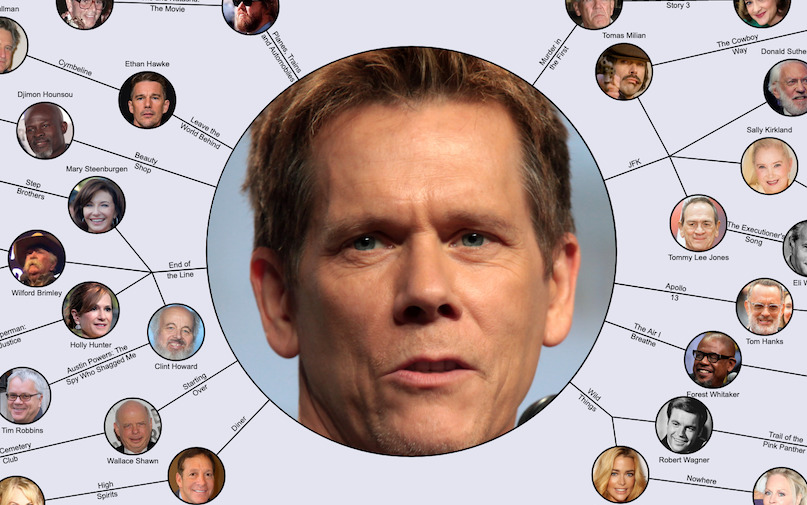
The Six Degrees of Kevin Bacon game challenged people to connect any actor to Kevin Bacon through films they had appeared in together. At first it sounded like nothing more than a fun pub quiz, yet underneath it lay a practical demonstration of graph theory and shortest-path algorithms.
The idea became so popular that computer scientists developed the Oracle of Bacon, a searchable database capable of calculating the shortest acting path between Kevin Bacon and every other actor in the industry. Even more remarkable is that the average Bacon Number is now fewer than three, highlighting just how interconnected Hollywood has become.
The game became so influential that mathematicians later created the Erdős–Bacon Number, combining academic publishing networks with Hollywood acting networks to show how seemingly unrelated worlds overlap.
For me, the Kevin Bacon example has always illustrated a much bigger point. Every profession has its own network. Every industry has its own bridges. Hollywood simply made those bridges visible.
Then Came Social Media
When Milgram carried out his experiment, relationships were maintained through face-to-face meetings, telephone calls and handwritten letters. Building a network took years, and keeping it active required genuine effort.
Today, our professional lives look completely different.
A single individual may have hundreds or even thousands of LinkedIn connections. They may belong to professional associations, contribute to online communities, attend international conferences, collaborate remotely with colleagues across multiple countries and reconnect with former classmates at the click of a button.
Social media hasn’t changed the mathematics of network theory.
What it has done is expose relationships that were previously invisible while simultaneously creating countless new opportunities for connection. Every LinkedIn invitation accepted, every conference conversation continued online and every professional community joined creates another bridge within the global network.
The result is a world that feels dramatically smaller than it did only fifteen years ago.
Why LinkedIn Feels Like Three Degrees
Of all the social platforms, LinkedIn provides perhaps the clearest real-world example of network theory in action.
Unlike a traditional address book, LinkedIn doesn’t simply record who you know. It maps relationships between millions of professionals and instantly reveals the shortest path connecting you to someone you’ve never met.
How often have you searched for someone and discovered they are only a second- or third-degree connection? Perhaps a former colleague knows them. Maybe you both worked with the same client years ago, attended the same university or belong to the same professional body.
What once required weeks of phone calls and introductions is now visible in seconds.
Imagine wanting to meet the CEO of a global technology company. Years ago you might have assumed the opportunity was impossible. Today, LinkedIn might reveal that a former colleague knows an industry expert who has already worked with that CEO.
The path suddenly becomes:
You → Former colleague → Industry expert → CEO
Three introductions.
Not six.
Three.
Of course, LinkedIn hasn’t magically created these relationships. What it has done is reveal the network that already existed, while making it significantly easier to activate.
Has Six Degrees Become Three?
As tempting as it is to declare that the world is now officially connected by only three degrees, the evidence doesn’t quite support that conclusion.
The original six-degree concept described humanity as a whole. It included every culture, every country and every social context. Professional networks represent only one part of that much larger picture.
However, research into online social networks suggests that the average distance between people has indeed become shorter. Large-scale analyses of digital social graphs have found average path lengths closer to four than six, reflecting the impact of online platforms in creating and exposing social connections.
This is where I think professional networking deserves its own conversation.
Within many industries, our networks overlap in multiple ways. We work for the same employers, attend the same conferences, study at the same universities and belong to the same professional communities. Those overlapping circles create dense clusters of relationships where the practical distance between two professionals often feels much closer to three than six.
So perhaps “three degrees of separation” isn’t a new scientific law.
Perhaps it’s simply the reality of modern professional life.
Why It Matters
This isn’t just an interesting theory for mathematicians.
It changes how opportunities arise.
It changes how businesses grow, how ideas spread, how innovation happens and how careers develop. The most valuable opportunities rarely come from complete strangers. More often they arrive through someone who knows someone you already trust.
That is exactly what network theory predicts.
It also explains why genuine networking has become far more valuable than simply collecting contacts. A network isn’t measured by the number of names in your LinkedIn profile. It’s measured by the quality of the relationships that connect those names together.
Every authentic conversation creates another bridge.
Every collaboration strengthens the network.
Every introduction has the potential to shorten the distance between people who may eventually achieve something remarkable together.
Final Thoughts
When I first encountered network theory during my PhD fifteen years ago, six degrees of separation felt almost magical. The idea that billions of people could be connected through only six relationships fundamentally changed the way I thought about society, organisations and human behaviour.
Looking back today, I find myself wondering whether the digital age has quietly transformed that idea.
Not because the mathematics is wrong, but because our networks have become richer, denser and infinitely more visible.
LinkedIn, and platforms like it, haven’t just helped us connect with more people. They’ve revealed how closely connected we always were.
Perhaps the world is still six degrees apart.
But when I look at today’s professional landscape, I can’t help feeling that many of us are already living in a world of three.
And if that’s true, then your next customer, your next business partner, your next mentor—or even your next life-changing opportunity—may be only three introductions away.
References
Milgram, S. (1967). The Small World Problem. Psychology Today, 2(1), 60–67.
Watts, D. J., & Strogatz, S. H. (1998). Collective Dynamics of “Small-World” Networks. Nature, 393, 440–442. https://doi.org/10.1038/30918
Watts, D. J. (2003). Six Degrees: The Science of a Connected Age. W. W. Norton & Company.
Backstrom, L., Boldi, P., Rosa, M., Ugander, J., & Vigna, S. (2012). Four Degrees of Separation. Proceedings of the ACM Web Science Conference.
Zhang, Z., Zhou, X., & Ning, H. (2022). When Six Degrees of Separation Meets Online Social Networks: How Low Can the Degree Be? arXiv:2209.06577.
The Oracle of Bacon – https://oracleofbacon.org
The Erdős–Bacon Number Project – https://oakland.edu/enp/